
More Wins, More Hope – The Pittsburgh Foundation Joins the Fight Against Heart Failure
Long before HBO Max’s The Pitt series, Pittsburgh enjoyed a vaunted place on the map for medical innovation and prioritizing patient care. Pittsburghers know they live in a region with some of the most cutting-edge doctors, researchers and medical care available. As part of its mission, The Pittsburgh Foundation has prioritized its role as a funder of this innovation. Healthy communities are innovative communities, and some of the best examples of that innovation can be found among the healthcare teams that are addressing heart health in Pittsburgh.
Recent Pittsburgh Foundation funding has benefited two programs focused on forms of heart failure. They are the AGH Extracorporeal Membrane Oxygenation Patient Mobility program at Allegheny General Hospital and the Richard S. Caligiuri Cardiac Amyloidosis center at the University of Pittsburgh Medical Center (UPMC). “Failure” might be key to this disease state’s name, but these days an abundance of success is spurring new hope.
Like a “Trust Stand” – A Mobility Program for the Sickest Heart Patients
Tony Kuniak was a runner with his coworkers, until shortness of breath led him to a heart failure diagnosis and an implantable cardioverter defibrillator (ICD), which is implanted in the chest to monitor the heart and deliver a powerful shock when it senses failure.
The ICD lasted 14 years without incident, but Kuniak’s doctors had told him that “everything will be normal, until it isn’t.” One day in 2022, at his camp by himself in the Allegheny National Forest, his heart needed its first shock from the ICD. “As I was walking, all of the sudden everything turned white from the ground up, I remember just seeing the tree tops. Fearing I was going to pass out, I lay down on the ground, then everything went black. I passed out and when I woke up I was standing, and it felt as if I’d taken a massive hit to the chest,” he says.
So began a new leg of his journey, and for the next 22 months he would need multiple visits to the ER in response to repeated ICD shocks that left him walking on eggshells, never knowing when the next shock would hit.
The date of his heart transplant, 4/12, feels like a reminder of how steeped Tony and his wife Patti are in their beloved Pittsburgh with its 412 area code, and how much they owe to Pittsburgh physicians. But he almost didn’t make it to that transplant that saved his life. Even after the right sized heart, with the necessary O-positive blood type, had become available, severe storms in the south meant that the donor heart delivery was delayed.
Patti was nervous when doctors at AGH said they needed Kuniak to go on Extracorporeal Membrane Oxygenation (ECMO) as they waited for a heart. The ECMO machine would divert blood from the body and oxygenate the cells, in essence doing the work of the heart and lungs. She had heard that 50 % of patients, by the time they need ECMO, don’t survive. She knew that, although ECMO had potential to prolong a life, the longer a patient’s blood was directly exposed to oxygen through the machine, the more damage would be done to the blood cells.
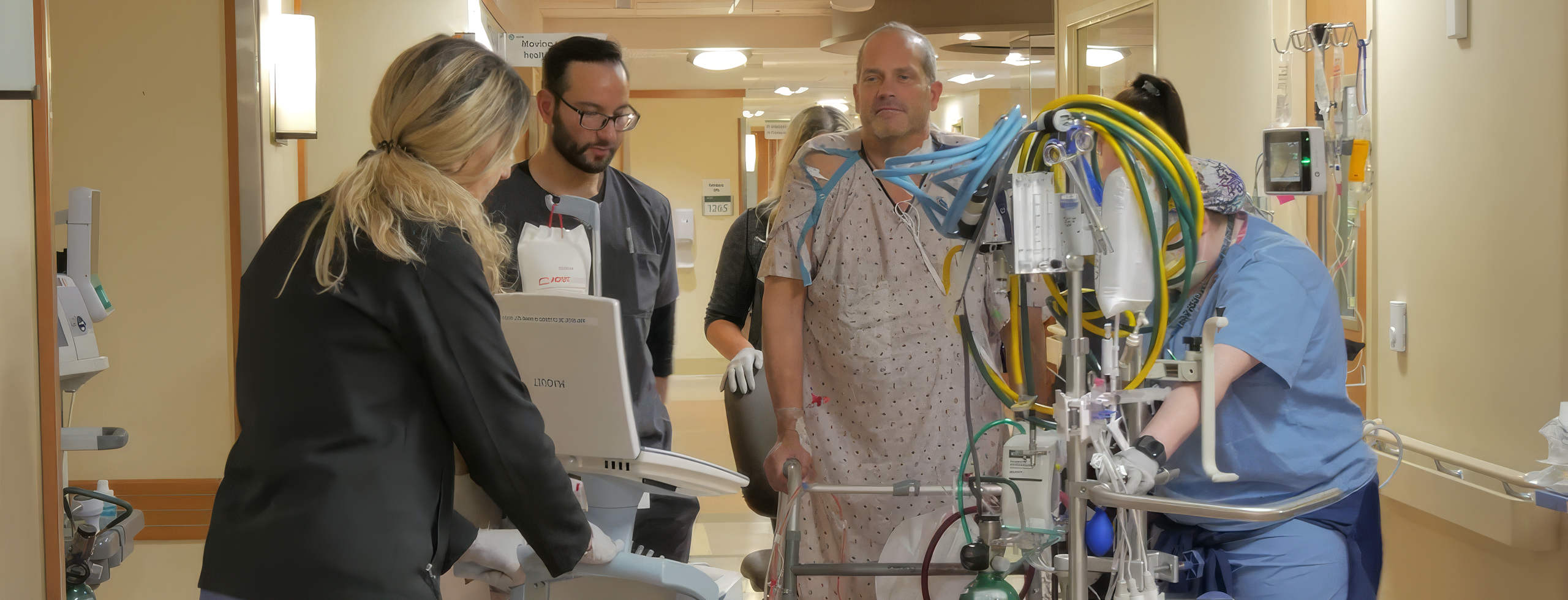
Caregivers have long had the same concerns as Patti’s, which was why AGH had recently spearheaded a new program to test new ways to counter some of the known ECMO side-effects. Kuniak had been on ECMO for twelve hours, wondering if he could hold out for his heart, when a team of five gathered in his room and asked him if he would try walking.
“They wanted me to get up and walk?” Kuniak said of the moment. “All these giant tubes are going in and out of my body. I wondered how I could even stand up, much less walk. But I was feeling claustrophobic. So, I thought ‘ok, maybe I’ll make it to the hallway.’”
The team encircled him, helping him first with slow leg movements while still prone, then elevating the bed to a standing position, allowing him to slowly step forward. “Instead of a trust fall, it was like a trust stand,” Kuniak says. “And when I walked, I made it further than I expected, all the way to the nurses’ station and back. It was more challenging than anything I’d ever done, but so worth it,” he says. “You have this group of people focused on your every move, and you’re trying to make your muscles work. Your head clears. It was such an important change from all those hours lying in bed without anything good happening.”
Fortunately for Kuniak, his heart arrived and he received his transplant. By October of 2024 he was out hunting again, his new heart working and his story another proof point that heart transplantation has come a long way. And when it comes to ECMO, that walk to the nurse station is also a giant leap forward.
The progressive mobility protocol employed by AGH’s program has led to improved survival in this incredibly sick cohort, with half of the patients placed on ECMO support regaining their native heart or lung function or being bridged to advanced heart therapies such as a durable left ventricular assist device (LVAD) or a heart transplant. While national mortality rates for ECMO patient have ranged from 40-60%, patients that have successfully participated in this mobility program have demonstrated an impressive mortality rate of only 18%.
Doctor Shan Modi, cardiothoracic critical care physician and a lead physician on the mobility program, helped develop the protocol and data tracking platform for proving the effectiveness of pursuing ECMO patient mobility.
In part through data analysis funded by the Pittsburgh Foundation, Modi’s team has proven that mobility for patients is not only doable, but that it results in much-improved outcomes. “It takes a total culture change, but with more wins, there is more excitement about what’s possible,” Dr. Modi says. Tracking survival rates, time to recovery, complications, eligibility for advanced therapies, and discharge times all require data management tools, like that funded by the Pittsburgh Foundation, and provide the needed proof for facilities nationwide, even worldwide, to follow suit.
With a four to six person team present – ECMO specialist nurses, cardiovascular perfusionists, cardiothoracic rehabilitation therapists and other clinical experts – this commitment to the patient looks a bit like slow-motion choreography. ECMO cannula and tubes divert circulation through a membrane oxygenator, while simultaneously removing carbon dioxide. Historically, teams have been too worried about a disconnect from the lifesaving machine, which could result in rapid, life-threatening blood loss.
Sometimes the concern is about migration of intra-aortic balloons (used to create negative pressure, through inflation and deflation, to assist with the movement of blood from the aorta to the rest of the body) or migration of temporary left-ventrical assist devices used in about 50% of patients in conjunction with ECMO support.
Ilija Klipa, an exercise physiologist with AHN and one of the clinical leads of the program, has been fine-tuning this mobility protocol since 2022, and says that the patients tend to hate him at first, but that over time they realize how their chance at survival with fewer complications is worth the effort.
“You can’t buy a race car without an adequate driver and full pit crew,” says Dr. Modi. He adds that the data proving their wins keeps the morale and momentum high.
And it’s not just about saving lives, it’s also about better odds for a future quality of life. Too much bedrest can lead to organ failure, sacral ulcers, dystrophy, even amputation.
“There are some patients who can’t leave their bedside to walk in the hallway, because they have experienced kidney failure and require dialysis. For them, we provide a treadmill and we were able to apply the Pittsburgh Foundation grant funds to that type of treatment,” says Modi. He said the Pittsburgh Foundation Medical Research Committee has been helpful in ensuring flexibility in how the grant money is allocated to address patient needs.
Having learned what is possible with ECMO in the hospital, the team is turning to other important gaps in care. AGH is one of only a few hospitals in the U.S. implementing new protocols to start a “mobile ECMO” program in which experts in ECMO are traveling to hospitals without ECMO expertise and place critically ill patients on ECMO support when needed. Patients are then transported back to AGH for further critical care needs and can bridge to heart transplant when necessary. In addition, AGH, in conjunction with UPMC, are the only two institutions in Pittsburgh that are qualified to place this device in patients who are experiencing active cardiac arrest, a form of ECMO support known as Extracorporeal Cardiopulmonary Resusitation, or ECPR for short. The criteria to qualify are intended to avoid risk of brain or debilitating organ damage: the patient must have received CPR within the crucial five minutes from heart failure, three initial attempts to shock the heart back into rhythm must have been ineffective, the patient’s heart must be shockable, and the patients must be between 18 and 65 and live within 45 minutes of an ECMO-capable hospital. Also, the patients must be free of prior neurocognitive or irreversible organ dysfunction. AGH clinicians say that six patients who were part of this protocol last year at AGH would certainly have died without it.
“The whole landscape has changed,” explains Dr. Modi.
As an evolution from cardiopulmonary bypass that is performed in cardiac surgery, ECMO is a form a bypass that is utilized outside of the operating room that diverts blood from the body, oxygenates the blood utilizing a membrane lung or oxygenator, and returns the blood with pressure to essentially bypass the lungs and the heart. Veno-arterial ECMO, or VA-ECMO, is the type of ECMO most typically utilized for heart failure and cardiogenic shock by supporting primarily the heart. (ELSO Red Book, 6th edition, Brodie). For patients with primary respiratory failure such as pneumonia or COVID-19, veno-venous or VV-ECMO can be utilized to primary bypass the lungs and assist in patient recovery (CESAR Study). ECMO has been now utilized in cardiac arrest to recover patients that would have died from conventional management of cardiac arrest. The ARREST trial from the University of Minnesota demonstrated that 1/15 (7%) of patients treated with traditional CPR survived to hospital discharge, versus six of 14 (43%) treated with ECMO. The results were so striking that the university’s ethics board ordered the study to be halted, determining that it would be unethical to continue treating patients by the standard method. Changes in culture and protocols, as well as data about outcomes, such as that from AGH, may improve ECMO access for more patients.
Michael Yonas, Vice President of Community Partnerships and Learning, feels that funding health advancements in the Pittsburgh area is critical to all the other ways the Pittsburgh Foundation can make a difference. “If you have community health, you’ve got a baseline for other enrichment of the community experience.”
Once Little Hope for Amyloidosis. Now Major Advancements Point to Longer Lives
Another sea change in heart disease treatment is taking place at the University of Pittsburgh Medical Center’s (UPMC) Caliguiri Cardiac Amyloidosis Center and cardiac centers worldwide. A disease once considered extremely rare, cardiac amyloidosis, also known as ATTR-Amyloidosis, is showing itself to be very much more common than once thought. Part of the belief in its rarity came from the fact that until a few years ago, invasive heart biopsy-testing for the disease was essential for the diagnosis, which left patients with no true next steps, given the lack of treatment options at the time.
Today, new nuclear cardiology scans provide non-invasive diagnostics that are revealing a high disease prevalence. “We see as many as three to five new patients a week,” says Dr. Prem Soman, the Richard S. Caligiuri Chair in Cardiac Amyloidosis, director of the Caliguiri Amyloidosis Center and nuclear cardiology, and associate chief of cardiology at the University of Pittsburgh Medical Center Heart and Vascular Institute. His Center is one of the fastest growing at UPMC. The Caligiuri Center and Chair are named after a beloved Mayor of Pittsburgh, who succumbed to amyloidosis in the 1980s.
While the disease once gave patients five to seven years to live at best, today patients have a much better prognosis, thanks to three different newly approved pharmaceuticals. The data are not yet in on how long patients can live with the new treatments, because these drugs have only been prescribed for less than a decade. But all indicators are for notable improvement.
In a recent video interview with Cardiovascular Business, Dr. Soman noted that “the data clearly show that acoramidis, one of the new therapies for ATTR amyloidosis, reduces both all-cause death hospitalizations due to heart failure, with durable effects over time. The findings also reinforce the importance of early diagnosis and prompt initiation of therapy.” Two other therapies have been shown to have similar effects.
The training of physicians in amyloidosis is a critical mission and the Pittsburgh Foundation has partnered with the Caliguiri Amyloidosis Center to create a physician fellowship.
Dr. Timothy Kim was the first such fellow, with a relaxed and friendly demeanor certain to put patients at ease. Kim remembers his first time learning about the big changes on the amyloidosis horizon, including the work of Dr. Soman, when he was participating in one of those invasive heart biopsies as a medical student.
“Dr. Soman is constantly giving talks, publishing papers, always working to raise awareness about amyloidosis – and that’s exactly what’s needed. The public attention, the funded programs, those are going to be the factors that will allow better health outcomes sooner and more broadly.”
Amyloidosis is a condition that results when body proteins become unstable and clump together to form deposits (called amyloid) in various organs, causing dysfunction and disease. Depending on the specific protein of origin, symptoms can vary, and some forms are genetic. ATTR-Amyloidosis or transthyretin amyloid cardiomyopathy (ATTR-CM), one of the amyloid forms that involves the heart, is caused by a protein called TTR and can sometimes be hereditary. It often causes deadly problems with the heart and nerves, and may also affect the spine, joints, eyes and other organs where the clumps, or fibril, have become numerous.
The community health benefits for amyloidosis have Dr. Kim particularly excited. A gene has been identified that can make an important difference for early diagnosis and treatment for ATTR-Amyloidosis. Because a person will have a 50% chance of having the gene passed to them if they have a parent with hereditary ATTR-Amyloidosis, a trial has been developed to serve those family members who may have the gene, but have not yet developed symptoms, to determine when these expensive therapies should begin. The Caliguiri Center is the only one in the region to have the trial available for patients. Should genetic testing identify the gene that puts them 100% at risk of eventually developing ATTR-Amyloidosis, their physicians can begin medication as soon as heart symptoms occur, instead of risking the lag time that often occurs from symptom presentation to diagnosis.
“The community impact is so important,” says Dr. Kim, noting that the inherited gene is more prevalent in the African American population. “Some of these people have seen their loved ones suffer greatly from the disease. The hope in knowing that suffering might be avoided – that’s huge.”
Lori White, RN BSN CCRN-K, is the Outpatient Nurse Coordinator on Dr. Soman’s team, which also includes Certified Nurse Practitioner Genise Green, Physician Assistant Elizabeth Luttner and amyloidosis specialists from other specialties like hematology, neurology and nephrology. White echoes the emotionally moving change happening with amyloidosis patients. “They hear the term amyloidosis, they Google it and think they’re going to die in just a few years. Dr. Soman gets them to a point where they know they’re not going to die tomorrow, there’s treatment, it’s going to be ok.”
Leonard Patrick, who also goes by “Wayne,” remembers the first time he knew something was wrong, coming up the stairs from his basement washer/dryer. He had to sit down on the steps because he couldn’t catch his breath. At the hospital, his oxygen levels were fine, which meant the problem was likely his heart. Given carpal tunnel symptoms he had, he was referred to Dr. Soman’s team. He can attest to the deep fear felt when first learning of his amyloidosis diagnosis, but, while he still tires easily, it’s four years since diagnosis and damage to his heart is not getting worse.
Now 82, Patrick and his wife Rose have decided that earlier plans to move to North Carolina are not as important as staying close to their healthcare team. Between the lifesaving treatment, careful watching of their two children who tested positive for the genetic marker, home physical therapy, and the behind-the-scenes paperwork of the nursing team, Patrick couldn’t be more relieved to live in a city where there’s finally hope for a disease that in the late ’80s ended Mayor Richard Caligiuri’s life. “We are blessed to have Dr. Soman and his crew,” says Patrick. “They are the most empathetic people.”
The Pittsburgh Foundation, among its many aims, dreams of removing obstacles, like illness, so that focus can be turned to the work of building stronger, more vibrant communities. With projects like these two addressing illness of the heart, the dream is that much closer to being real.
Related Content
The fourth pathway
Pittsburgh Foundation donors are the early investors at Hillman Cancer Center where immunology research is producing new tools to fight cancer.

Racing against amyloidosis and heart disease
On Oct. 5, The Pittsburgh Foundation’s Center for Philanthropy announced a new $2 million co-creation initiative to create an endowed research chair at the University of Pittsburgh School of Medicine.