Importance of supporting trauma care, combating illegal gun sales grounds gun violence prevention event
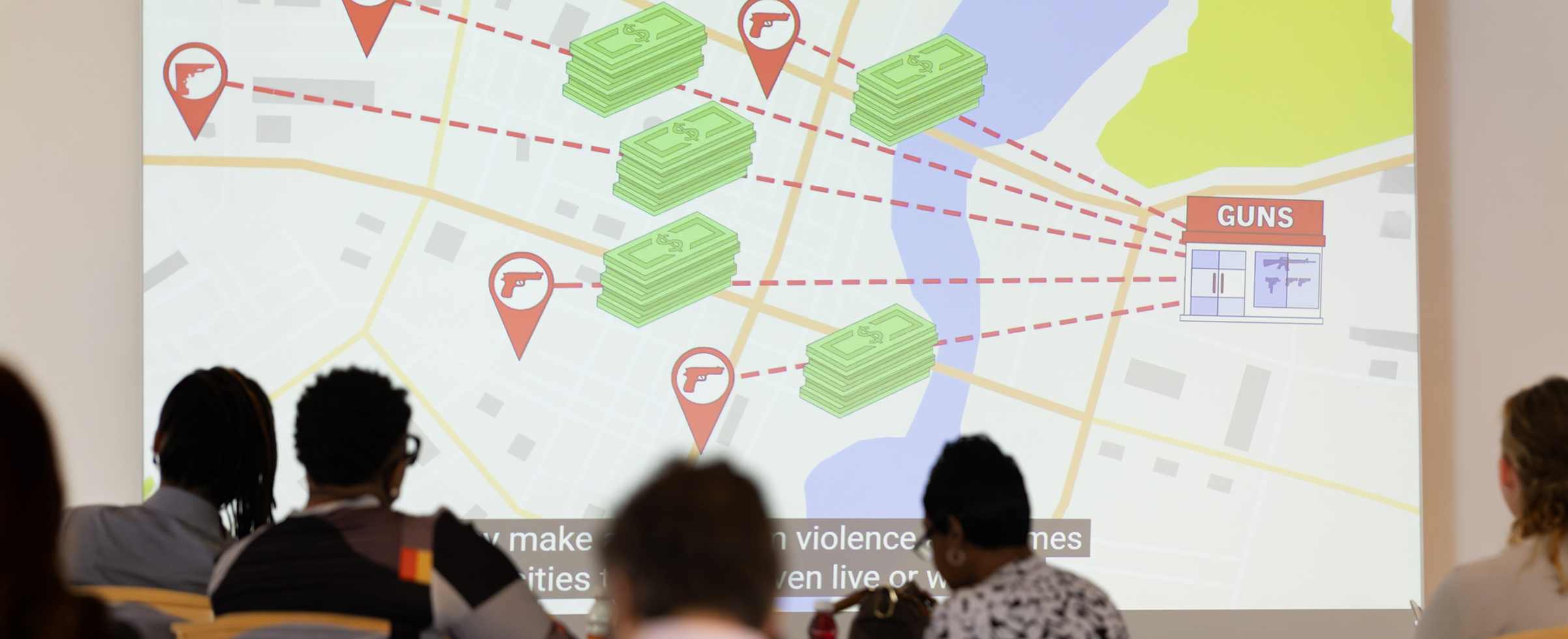
One in five Americans have had a family member fatally shot. And 90% of guns used in crimes originated from only 5% of gun dealers. Those two startling statistics highlight how many lives are forever altered by gun violence in the United States and where the weapons are coming from.
“Unaddressed trauma shatters the belief that a person is safe and that belief can be passed down through generations as social learning or maladaptive, criminalized learned behaviors,” said Dr. Toya Jones, Ed.D., LCSW, BASW program director and assistant professor at the University of Pittsburgh. Dr. Jones was one of the presenters during a recent convening hosted by The Pittsburgh Foundation, Brady United and seven local partners to discuss gun violence prevention and its ripple effects. “Simply put: When a survivor is surrounded by trauma triggers, they remain in the survivor's state of mind, causing them to react to potential or perceived danger out of the need to protect themselves or their loved ones.”
According to a study by Common Cause Consultants and commissioned by The Heinz Endowments and our Foundation, one in every eight children ages 14–17 in Allegheny County has witnessed a gun violence incident and nearly 51% of Black children ages 10–17 report hearing or seeing gun violence. These experiences produce anger, withdrawal, post-traumatic stress, and desensitization — contributing to depression, anxiety, post-traumatic stress and sleep disturbances among youth. As one participant in the study said: “Youth gun violence has caused individuals to become numb to death. Human life has been devalued — not only for the victim, but for the attacker, as well.”
Brady United states that community gun violence is a form of interpersonal gun violence that has four characteristics:
- It takes place in under-resourced neighborhoods and affects disinvested communities.
- It disproportionately impacts Black and Hispanic/Latino communities, specifically young Black and Hispanic/Latino men.
- It usually occurs outside of the home in a public setting and excludes domestic and intimate partner violence.
- And it is often sparked by a dispute between individuals or groups and may be retaliatory because of long-standing conflicts.
Research shows people gain access to guns through a very small subset of gun shops.
Ashley Johnson, Stoneleigh Fellow, Combating Crime Guns Initiative for Brady United, addressed the gun trafficking. She said gun violence is often discussed through the lens of individual behavior, but an important part of the conversation is understanding how firearms enter and circulate within communities. She noted:
- In Pennsylvania, 50% of crime guns traced to in-state dealers were sold by just 1% of dealers, and 90% were sold by 20% of dealers.
- Just 1.2% of Pennsylvania gun dealers were responsible for 57% of crime guns recovered in the state while approximately 86% of gun dealers in Pennsylvania did not have a single firearm traced back to them in a given year.
“Greater transparency around firearm trace data, along with stronger oversight and accountability for firearm dealers, can help policymakers and researchers better understand supply patterns and identify opportunities for prevention,” she said. “Strengthening collaboration between government agencies, researchers and community leaders is an important step toward building more informed and effective responses to violence.”
One of those government agency representatives who attended was Pittsburgh Police Chief Jason Lando, who lauded the event and expressed support for the organizations who are doing vital work in our community.
“I think it's an awesome opportunity,” said Chief Lando. “I think for far too long law enforcement has kind of been silent, and it's all about partnerships. We can't do our work without the support of the community. Particularly some of our violence interrupter groups, and the proof is in the pudding. Look at the last year, we have groups like REACH and AIM, for example, that are out there helping us in the community, and we've seen a drastic reduction in violent crime.
“A lot of the work that goes into reducing violent crime happens before anyone even picks up a gun. And it's the work that some of our non-police partners are doing to, for lack of a better term, ‘chill things out’ in a neighborhood or in a community, so people don't even pick up that gun and try to hurt someone. This is where it all comes together.”
Ways to Get Involved |
|---|
|
About the Event
In March 2026, a group of local gun violence prevention professionals with the Community Violence Reduction Initiative (CVRI), advocacy experts, community leaders and mid-Atlantic representatives from Brady United assembled for a half-day gathering centered around how to support a safer community by integrating trauma awareness and care with gun violence intervention methods that identify and eliminate illegal gun sales in the region. This convening was a direct result of the three-part Protecting Our Youth from Gun Violence convenings by cultivating and supporting these expert relationships, consistent with our commitment to deepening and fostering community, institutional, policy and provider partnerships to address critical issues facing Allegheny County, including gun violence prevention and intervention.
Collaborating organizations included: Allegheny County Department of Human Services, Brady United, City of Pittsburgh, Common Cause Consultants, Duquesne University, Grace United Church of Christ, The Heinz Endowments, Operation Amani, Operation Better Block, The Pittsburgh Foundation and Steel Smiling.
View photo gallery from the event
Related Content